Understanding results
Individual results
TrichoScan results are based on high-resolution images of a small scalp area captured with a dedicated camera and then analyzed by software. This makes it possible to record hair characteristics objectively and document changes reliably. The most meaningful information usually comes from following your individual values over time.
Hair density
Shows how many hairs are present in a defined scalp area.
→ In simple terms: how dense the hair appears
Diameter / miniaturization
Measures the thickness of individual hairs and shows differences within the hair pattern.
→ In simple terms: how thick or fine the hairs are and how uniform they appear
Cumulative hair thickness density (hair mass)
Combines hair density and hair thickness into one overall value.
→ Describes how full or voluminous the hair appears overall
Terminal/vellus hair ratio
Distinguishes between strong, thicker terminal hairs (> 40µm) and fine, thinner vellus hairs (≤ 40µm).
→ Helps show how strong or fine the overall hair pattern is
Follicular units
Scalp hair often grows in small natural groups. Each group is surrounded by fine connective tissue in the scalp, and different numbers of hairs can grow from each group. The measurement describes how many of these hair groups are present, whether as single hairs or small bundles.
→ Can provide an indication of the available follicular units, for example in the context of hair transplantation
Anagen/telogen ratio (not with TrichoScan FAST)
Shows the ratio between growing hairs (anagen hairs) and resting hairs (telogen hairs).
→ In simple terms: how many hairs are actively growing compared with those in a resting phase
How to interpret the results
Every person has an individual hair pattern shaped by genetics and other personal characteristics. That is why there are no fixed “ideal values” or normal values that apply to everyone. The measurement result also depends on the chosen measurement site. If that site changes, the results will always differ.
A TrichoScan analysis is not comparable to a blood test with fixed reference ranges. TrichoScan is designed to show the individual development of hair loss: how do the values change over time? That is exactly where the analysis becomes useful by making those changes visible and understandable.
TrichoScan is used for the objective analysis and documentation of hair characteristics. It does not provide medical diagnoses or treatment recommendations.
What an evaluation can look like
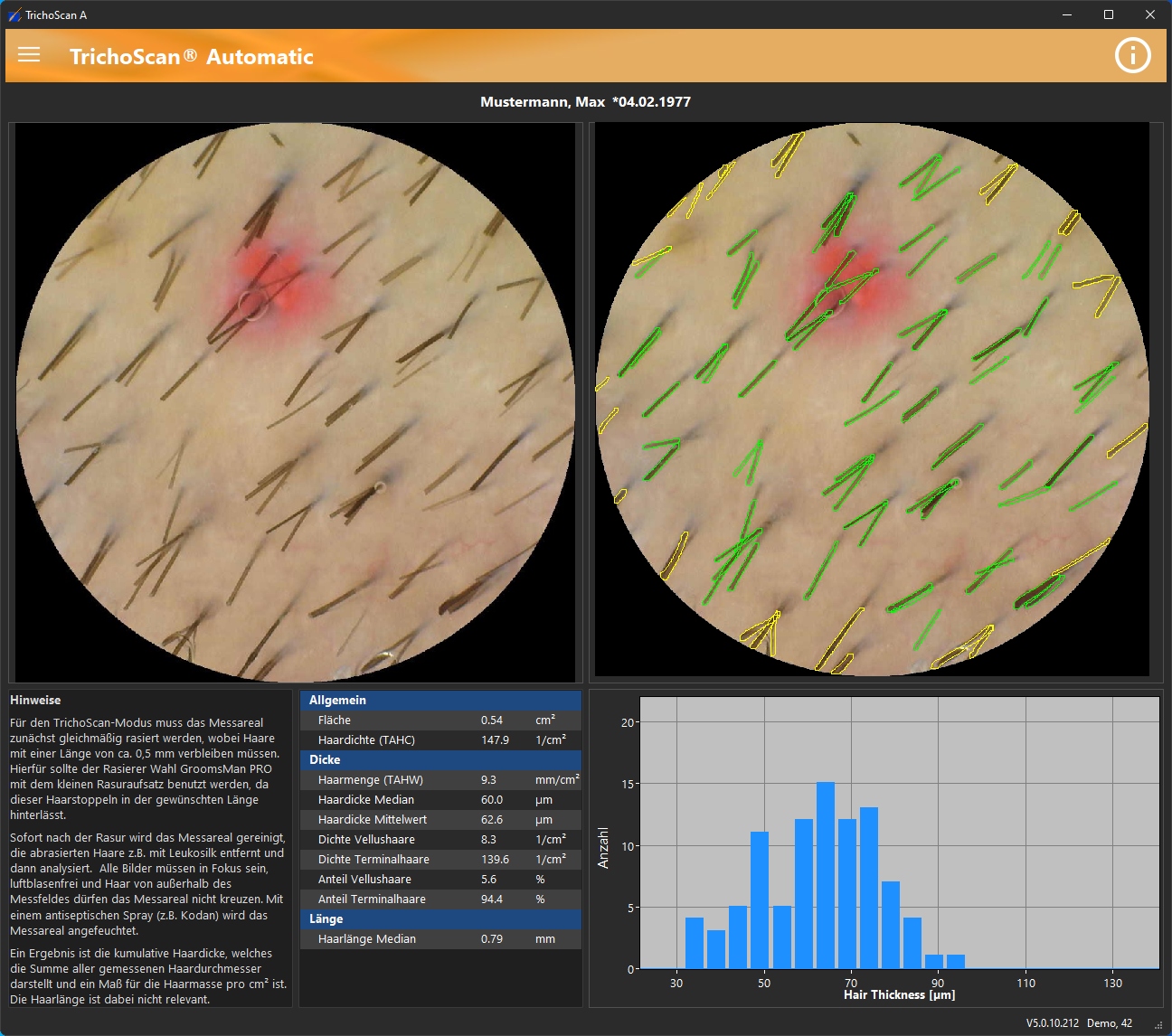
After image capture, the software marks the detected hairs and calculates key values. The following screenshots (Image A1 and A2) show examples of what such a display can look like in a TrichoScan Professional 5.0 analysis.
In both images, the hairs in the measurement area were trimmed.
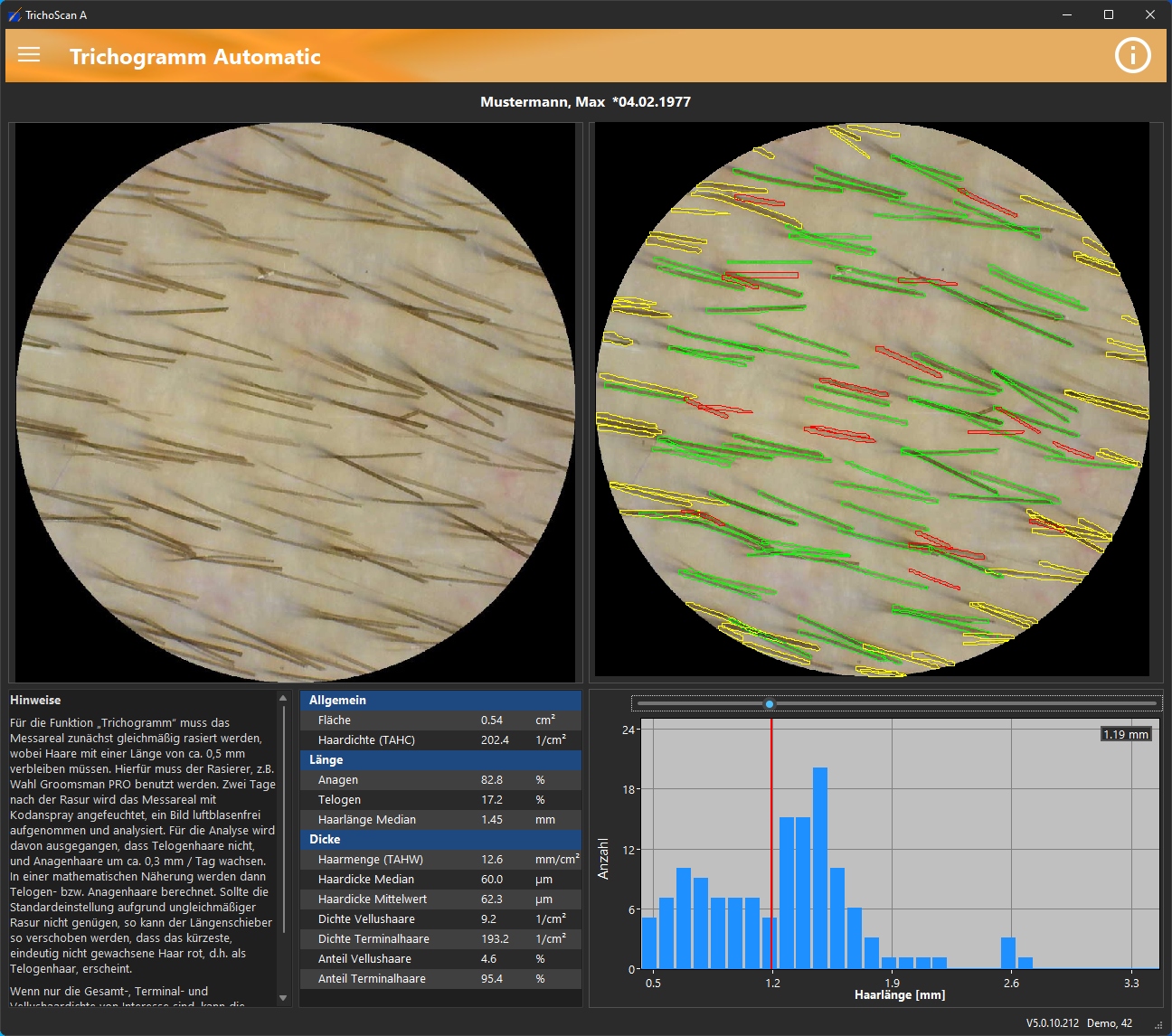
In the digital trichogram (Image A1), hairs marked in red have not grown and are therefore counted as telogen/catagen hairs. Green marks growing anagen hairs. A digital trichogram can be derived from this measurement. Yellow marks hairs whose beginning or end lies outside the measurement area. Statistical methods include these only partially in the total hair density.
Image A2 shows the automatic immediate TrichoScan evaluation. This type of evaluation is useful for follow-up monitoring.